
The Los Angeles of Crime Family: Cliff Dorfman on Reinvention, Hollywood History and the City Beneath the Postcard

Los Angeles has always been fertile ground for great crime stories. Beneath the glamour lies a city built on reinvention, ambition, loyalty, betrayal, and blurred lines between truth and performance—making it the perfect backdrop for noir, Hollywood scandals, and modern thrillers alike.
Those themes are at the heart of Crime Family, the debut novel from acclaimed screenwriter, director, and producer Cliff Dorfman. To celebrate its July 21 release, Dorfman will appear at the legendary Book Soup in West Hollywood for a special conversation with longtime friend, collaborator, and actor Seth Green, whose own decades in Hollywood make him an ideal guide through the novel's distinctly Los Angeles world.
Ahead of the event, we spoke with Dorfman about the real Los Angeles woven throughout Crime Family—the landmarks, neighborhoods, forgotten history, and complicated relationship between identity and reinvention that define both the city and his novel. We also asked Green to share a few of the places, films, and cultural touchstones that best capture the Los Angeles he knows.

Few cities have inspired as many stories as Los Angeles. It is a place where ambition collides with illusion, personal histories are continually rewritten and the line between performance and reality is often difficult to distinguish. Those tensions are at the heart of Crime Family, the debut novel from screenwriter, director and novelist Cliff Dorfman.
Set against a richly detailed Los Angeles, the crime thriller explores family legacy, loyalty, identity and the city's enduring promise that anyone can become someone else. Dorfman co-wrote the acclaimed film Warrior, which earned Nick Nolte an Academy Award nomination for Best Supporting Actor, and was nominated for a Writers Guild of America Award for his work on HBO's Entourage. He also wrote and directed the upcoming feature film 86, starring Stephen Amell, Erika Christensen, Seth Green, Matt Walsh, Cassandra Jean Amell and Andre Royo. Crime Family is out July 21 — order your copy here.
Born and raised in New York and now based in Los Angeles, Dorfman has spent his career moving between the immediacy of cinema and the depth of literary fiction. Ahead of the July 21 publication of Crime Family, we asked him about the real Los Angeles hiding between the pages of the novel.
That evening, Dorfman will celebrate the book's release at Book Soup, one of LA's most iconic literary institutions, in conversation with his longtime friend and 86 collaborator Seth Green.
The two go back through years of working together in this town, and Green is not simply moderating the event: as an actor, writer, director and producer who has spent decades working in Los Angeles, he shares Dorfman's deep familiarity with the city, its entertainment industry and the frequently strange distance between Hollywood mythology and everyday life. Before the two take the stage, we also asked Green to share a few of the places, landmarks and cultural touchstones that define his Los Angeles.

A Conversation with Cliff Dorfman

Los Angeles feels like more than just the setting of Crime Family—it almost becomes another character. What is it about LA that made it the only place this story could happen?
Because LA is the only city in America built entirely on the promise that you can become someone else. Everybody here is running a 2.0 version of themselves: the one they sold at the meeting, the one in the headshot, the one they came west to reinvent.
My antihero, Chase Forman, is a man who never knew who he actually was to begin with. You can only sculpt that sort of origin story in a city that treats identity as something you manufacture and sell. Put that character in Chicago or Boston, and the whole thing collapses. LA is the one place where the con and the confession are the same sentence.
Crime Family is filled with real Los Angeles landmarks, neighborhoods and pieces of Hollywood history. Were there places you intentionally included because of their significance, or did they naturally become part of the story?
Both, and there's one choice that, for me, is the most deliberate thing in the entire book, buried so deep I bet almost no one will find it on their own. My character Kendra lives on Fountain Avenue. Not simply because it's a real West Hollywood street, but because of what Fountain means. As the legend goes, someone once asked Bette Davis what the best way for a young actress to make it in Hollywood was, and she deadpanned, "Take Fountain"—the quiet cut-through that runs parallel to Sunset, the street locals use and tourists never learn.
In another corner of the book, a man lies that his house on Sunset once belonged to Bette Davis, borrowing her name to feel bigger than he is. So the phony character reaches for the glossy version of Davis up on the Boulevard, while the honest character actually lives on Fountain.
That's the whole novel in two addresses: the performance up on Sunset, the truth on the side street. I planted that one on purpose. The Formosa Cafe and the Brown Derby are in there for their Old Hollywood lore; Fountain is in there for the people who know the quote.
Hollywood has always been built on reinvention. Your novel explores characters trying to escape their past while creating new identities. Do you think Los Angeles still represents that promise today?
It still sells the promise; it just charges more for it and delivers less. The old version was that you got off the bus and the town would let you disappear into whoever you wanted to be.
That still happens, but now everyone arrives with a phone documenting the before, without realizing that it makes the clean break harder. What hasn't changed is the hunger. People still come here to outrun something. The city still says, "Yes, you can be someone else here." It has just gotten more vicious about the price.
The novel references Old Hollywood, legendary producers, writers and the entertainment industry in ways that feel deeply authentic. Which forgotten era or chapter of Los Angeles history fascinates you the most?
The era when careers were made and stolen over lunch.
There's a strand in the book built on exactly that: a producer takes a creative to the Brown Derby, promises him money, residuals and a role opposite Burt Reynolds, shakes his hand, lies with his eyes and steals the credit anyway.
That was the real machinery of this town: the deal that lived and died in a booth, the handshake that meant nothing, the brutality dressed up as sophistication. The public remembers the stars. I'm interested in the men the stars were afraid of.
That world had a code and a cruelty I still find endlessly compelling, partly, I think, because it never really left. It just got a new, way more expensive stylist.
There's a version of Los Angeles tourists experience, and then there's the city Angelenos actually know. Which version were you trying to capture in Crime Family?
The second one, without apology.
The tourist LA is a photo op—the sign, the star on the sidewalk, the studio tour—and that's all well and good. But the real LA is the parking lot behind the restaurant where the actual conversation happens.
It's knowing that the guy claiming Bette Davis used to own his house is telling you everything about himself in one succinct lie that he believes with every fiber of his soul. I've never been interested in the postcard version. I wanted the town underneath it, the one you only get to see once you've stopped looking for the star on the Walk of Fame.
Without giving away spoilers, are there locations in the novel that readers could actually visit after finishing the book? If someone wanted to experience the Los Angeles of Crime Family, where would you tell them to start?
Yes—and I'd keep it to the handful that actually matter, because this isn't a book that hands you a map; it's a book that hands you a few rooms.
Start at the Formosa Cafe on Santa Monica Boulevard. Stand outside it, and you're standing where one of the book's ugliest, most public moments goes down.
From there, go to the corner of Sunset and Doheny Drive. In the book, it's Bar One, the hot room at the mouth of the Strip that Chase gets pulled into. Then walk the residential blocks off Fountain in West Hollywood, where the people in this book actually sleep, not just scheme.
If you want the last chapter of the tour, drive out to Little Beach House, Soho House's Malibu club. If you're lucky enough to know someone with a membership who can get you in, sit on the deck where the unemployed and the powerful trade the same nervous small talk.
Read the scene, then go stand in it. The city does the rest.
Organized crime stories and Hollywood stories often share similar themes—power, loyalty, ambition, betrayal and legacy. Did you always see those worlds as connected?
They're the same story with different hats.
Both are family businesses, close-knit organizations with astronomical odds of obtaining membership. Both run on loyalty until loyalty gets too expensive. Both are obsessed with legacy and terrified of being forgotten.
Both are also performances: the crime boss and the studio head are each playing a role for an audience, and both know that the second you believe your own performance—your own hype—you're finished.
I've spent more than 30 years in one of those worlds, so writing the other one felt more like translation than invention.
As both a screenwriter and novelist, you've spent years telling stories about complicated people. What does Los Angeles reveal about its characters that another city couldn't?
The gap.
In most cities, the distance between who a person is and who they're pretending to be stays hidden. In LA, it's the whole personality; everyone is visibly auditioning for a better version of their own life.
That gap is where the drama lives. It's where the lie lives, and the loneliness, and occasionally the truth. Another city hides that space. LA puts it on a billboard on Sunset.
Los Angeles has changed dramatically over the past few decades. Is there something about the city you've watched disappear that you wanted to preserve in Crime Family?
There's a corner in the book, Sunset and Doheny Drive, that was Bar One, the hottest club in Los Angeles when I was coming up. Everyone wanted in.
Then it became Bootsy Bellows, which friends of mine, David Arquette and John Terzian of The h.wood Group, owned. Now John and The h.wood Group are about to reopen the same space as a Japanese restaurant called Little Luck, which I'm certain will be the newest hotspot in LA within a week of opening.
That single address tells you everything about this city: it doesn't preserve; it replaces. The room where everyone fought to be seen becomes something else, and in a few years new players occupy the same location, continuing the same fight.
That's one of the many things I love about Los Angeles and what I wanted to hold onto in the book—not the club itself, but the LA that keeps erasing the places that made it. A novel is one of the few things that refuses to gentrify. You write the room, and it stays open forever.
If someone had never been to Los Angeles and Crime Family was their introduction to the city, what do you hope they would understand about it that they wouldn't learn from movies or television?
That it's a real place where real people live and work and struggle, not a set.
The movies sell you the glamour, the seductiveness and the wealth porn, while noir sells you the menace. But they all leave out the ordinariness underneath: the working city, the enormous loneliness of a place this spread out, the fact that behind every glossy address is somebody who is one bad month away from losing it.
LA isn't a fantasy or a cautionary tale. It's a company town where the company happens to be dreams. I'd want them to feel how human it is once you turn the camera off. That's the LA I live in. That's the LA I'm in love with.
Every Angeleno has places that shaped them. Is there one location in Los Angeles that has had the greatest influence on you as a writer?
You wouldn't expect me to say a city made me a writer. I spent years doing everything I could to avoid writing.
I grew up in Merrick, out on Long Island, but nothing I put down there was real. Everything that ever actually came out of me came out of Los Angeles, and out of the night.
The specific place was a little oxygen bar that opened in 1996 on Sunset at Holloway, the corner where State Social House sits now, a short walk up the block from Book Soup. Oxygen bars were brand new then, a total only-in-LA idea, and I wandered in one night not knowing what the stuff would do to you.
I went home lit up, climbed the stairs of the loft I was living in on Cochran and wrote the story for my first film. I gave it to my dear friend Jonathan Silverman—Weekend at Bernie's, The Single Guy—who is one of the main reasons I have a life in this city at all. He has opened half the doors I've ever walked through in this town, and he believed in it enough to put it in front of Bob Saget. Bob believed in it enough to write the screenplay with me.
So my whole writing life was conceived at an oxygen bar and born in a loft on Cochran, both within walking distance of the store where, 30 years later, I'm launching my first novel.
That's not "a" location that shaped me. That's "the" location. LA didn't just set my work. It started it, on a random night, in a room full of hot air.
On July 21, Crime Family is released, and that evening you'll be celebrating with Seth Green at Book Soup—one of LA's most iconic literary institutions. What does launching this novel at Book Soup mean to you, and what can readers expect if they come to the event?
Book Soup is the real thing: an iconic institution that hasn't changed its name or mission since it opened more than 50 years ago. It's one of the last great independent bookstores in America, on the Strip, exactly where a book like this should be born.
Launching it here instead of some anonymous room means something to me; it's a hometown story getting a hometown christening.
As for the night, Seth Green is moderating, and anyone who knows Seth knows it won't be a polite author reading. It'll be a conversation: funny, fast, honest and probably a little dangerous.
Come for the book; stay because two guys who love this city are going to actually talk about it. And I'll sign whatever you put in front of me.
Seth Green's Los Angeles
On July 21, Seth Green will join Cliff Dorfman at Book Soup to celebrate the release of Crime Family. Green also appears in Dorfman's upcoming film 86, making him an especially fitting partner for a conversation about Dorfman's work, creative process and distinct vision of Los Angeles. Before the event, we asked Green to share a few of his own favorite places and perspectives on the city.

What's your favorite Los Angeles neighborhood?
I've always loved the Melrose area, from Hancock Park to San Vicente.
What's your favorite Old Hollywood restaurant?
It's gotta be Musso & Frank Grill.
What's a hidden LA gem everyone should experience?
I used to love the old Hollywood Billiards at Hollywood and Western, but it collapsed in the 1994 earthquake. You can still visit that corner. I believe there's a CVS and a subway station there now.
Where do you go in LA to clear your head?
I go home.
What's the city's most underrated landmark?
I would argue that Mann's Chinese Theatre is underrated, even though it's visited by tens of thousands of people every day.
I still think what it represents, how it fits into the history of our city and what the city was built on leaves it a bit underrated.
What's one book every Angeleno should read?
Charles Bukowski's Hollywood.
What film captures Los Angeles better than any other?
I really love Once Upon a Time… in Hollywood, as well as Swimming with Sharks and Where the Day Takes You. Those all feel like unique perspectives on the Los Angeles experience.
If you had one day to show someone the "real" Los Angeles, where would you take them?
We'd probably start under the bridge downtown where Anthony Kiedis drew some blood, then hit Venice to buy mushrooms and get tattoos.
Then we'd head down to Inglewood to see a show at the Forum. Afterwards, we'd make our way up to CityWalk—not City Wok; I'm notcasting shade, just making the distinction—and then we'd end up at one of the city's 30,000 great restaurants to have the best meal of our lives.
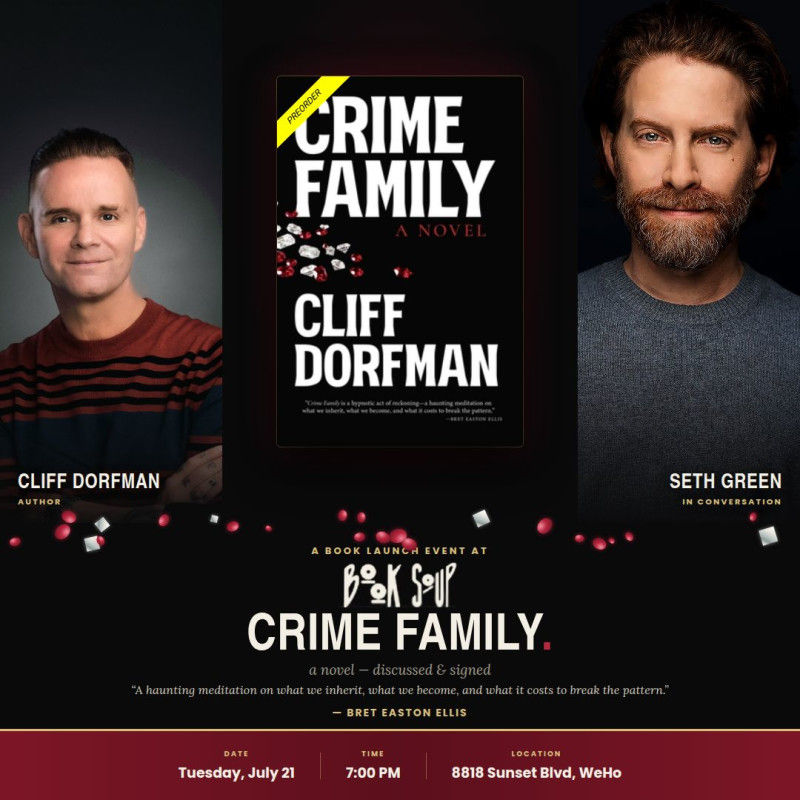
Crime Family is out July 21. Order your copy now, and join Cliff Dorfman in conversation with Seth Green on Tuesday, July 21, at 7PM!
Book Soup: 8818 Sunset BoulevardWest Hollywood, California
The audiobook of Crime Family will be available beginning July 28.


Great insights. I’ve been exploring AI image tools like anyscene lately—the creative possibilities are pretty impressive.
I really enjoyed the discussion about how Los Angeles continues to evolve while still holding onto its history and identity. The idea of reinvention also applies to how businesses build their presence online today. For example, practices in competitive fields like cosmetic dentistry need to continually improve how they connect with people searching for their services. This is where SEO for cosmetic dentists can help practices become more visible to potential patients while building trust through useful, relevant content. Great insights throughout the article!
This is one of the better tutorials I've come across recently. Instead of making things complicated, you explained every step in a simple and practical way. After following your guide, I was able to use pindownload successfully within a few minutes. Thank you for sharing accurate and useful information that saves people time.
Trump threatens kambikuttan new tariffs on European allies over Greenland until deal reached, as thousands protest
Trump threatens Kannada Stories new tariffs on European allies over Greenland until deal reached, as thousands protest