
Pasadena Architecture Tour: Historic Homes, Bridges, Mansions & the Story of the Arroyo Seco
To walk through historic Pasadena is to move through several versions of Southern California at once: Indigenous landscape, agricultural colony, winter resort, Arts and Crafts laboratory, civic showpiece, preservation battleground, and architectural dreamscape. Few cities in Los Angeles County hold so many layers in such a compact and walkable setting.
Pasadena is not simply one of Southern California’s most beautiful cities. It is one of the clearest places to understand how Los Angeles became Los Angeles.
Long before Pasadena was known for the Rose Parade, the Rose Bowl, grand Craftsman homes, historic bridges, and tree-lined mansion streets, it was a landscape shaped by the Arroyo Seco: the deep seasonal canyon that runs from the San Gabriel Mountains toward the Los Angeles River. The Arroyo gave Pasadena its geography, its views, its earliest sense of retreat, and eventually, its architecture.
To walk through historic Pasadena is to move through several versions of Southern California at once: Indigenous landscape, agricultural colony, winter resort, Arts and Crafts laboratory, civic showpiece, preservation battleground, and architectural dreamscape. Few cities in Los Angeles County hold so many layers in such a compact and walkable setting.
LA Explained’s Pasadena Architecture & History Walking Tour explores this story through the city’s most important landmarks, including the Arroyo Seco, Vista del Arroyo, the Colorado Street Bridge, Holly Street Bridge, the Gamble House, the Rose Bowl, Frank Lloyd Wright’s Millard House, the Bentz House, Fenyes Mansion, Grand Avenue mansions, and the Park Place-Arroyo Terrace Historic District. Together, these stops reveal how Pasadena became one of the great centers of historic architecture in Southern California.

Pasadena’s Origin Story: From Indiana Colony to “Crown of the Valley”

Pasadena’s modern origin begins in the 1870s, when a group of Midwestern settlers formed the San Gabriel Orange Grove Association and purchased land near the Arroyo Seco. The settlement was first known as the Indiana Colony, reflecting the background of many of its early residents. In 1875, the community adopted the name “Pasadena,” often translated as “Crown of the Valley.”
The timing was critical. Southern California was being aggressively promoted as a place of health, sunshine, citrus, and possibility. Railroads, booster campaigns, and the mythology of the California climate transformed Pasadena from an agricultural settlement into a fashionable winter refuge for wealthy Easterners and Midwesterners. What began as a colony soon became a resort city.
This shift explains so much of Pasadena’s built environment. The city’s early architecture was not just about shelter; it was about arrival. Pasadena became a place where people came to reinvent themselves, escape brutal winters, cultivate health, display wealth, and experiment with new forms of domestic life. The result was a city of gardens, hotels, mansions, bungalows, bridges, clubs, cultural institutions, and residential districts that reflected both aspiration and imagination.

The Arroyo Seco: Pasadena’s Natural and Cultural Spine
The Arroyo Seco is the foundation of Pasadena’s story. Literally meaning “dry stream” in Spanish, the Arroyo is a canyon, watershed, parkland, transportation corridor, and cultural landscape all at once. It shaped where people settled, where roads and bridges were built, where grand hotels took advantage of views, and where some of the city’s most important homes were sited.
For early residents and visitors, the Arroyo represented the romance of Southern California landscape: rugged, picturesque, and close to the mountains, yet accessible from the growing city below. By the early 20th century, the Arroyo had become central to Pasadena’s identity as a place of outdoor living, recreation, and architectural experimentation. Cabins, trails, parkland, bridges, and civic improvements gradually transformed the canyon into one of the region’s most important cultural landscapes.
On a Pasadena walking tour, the Arroyo matters because it explains the city’s architecture. Homes were designed to capture views, respond to terrain, and blur the boundary between indoors and outdoors. Bridges were built not simply as infrastructure, but as civic monuments. The Rose Bowl was placed inside the Arroyo because the landscape itself could hold spectacle. Pasadena’s relationship to the Arroyo Seco is one of the great urban design stories in Southern California.
Vista del Arroyo: From Resort Grandeur to Federal Landmark
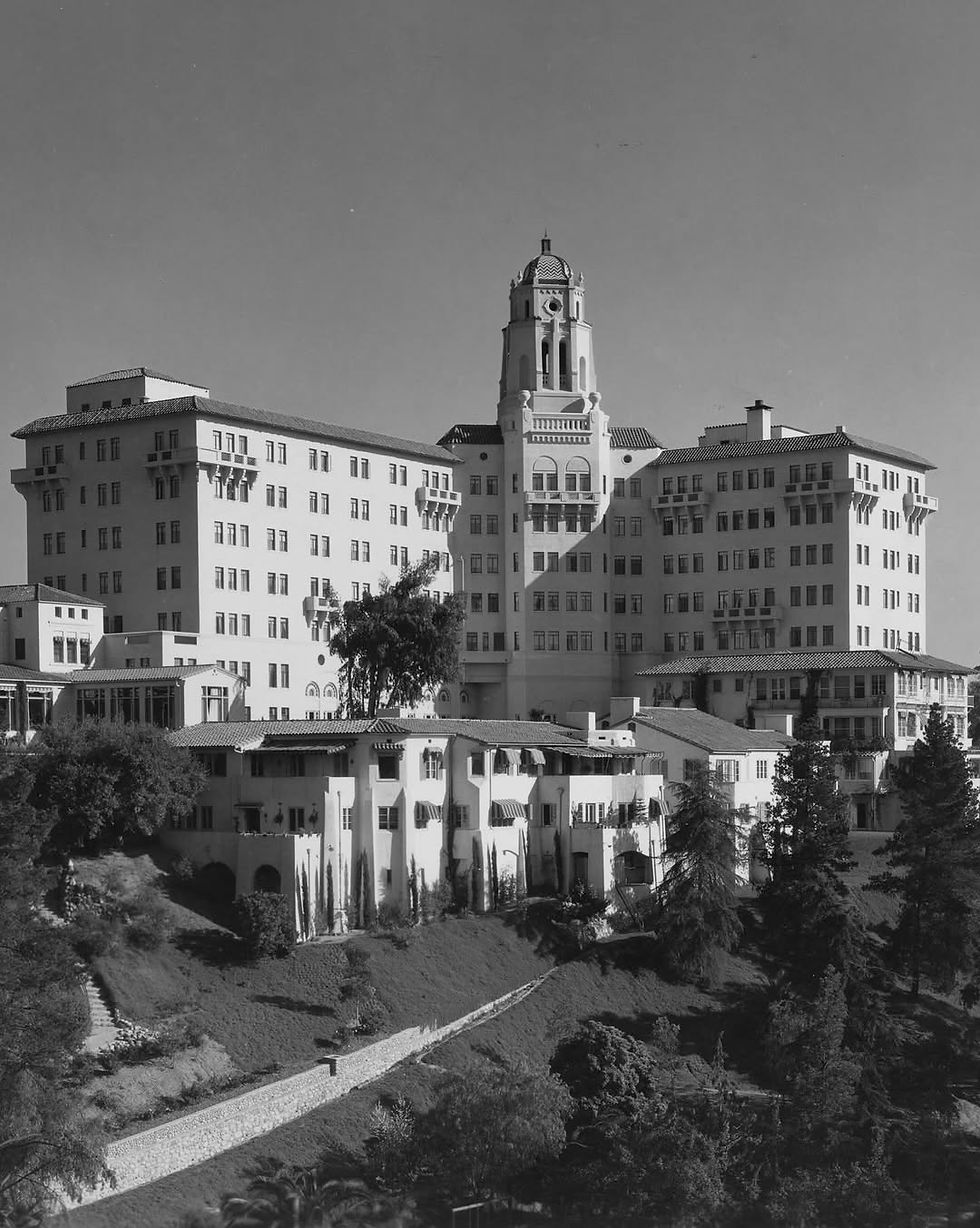
Overlooking the Arroyo Seco, Vista del Arroyo is one of Pasadena’s great symbols of transformation. Today, the property is home to the Richard H. Chambers United States Court of Appeals, but its origins are rooted in Pasadena’s resort era. The site was originally developed as a hotel property in the early 20th century, when Pasadena’s climate and scenery made it one of the West’s most desirable winter destinations.
The building most associated with Vista del Arroyo reflects the Spanish Colonial Revival style that became deeply connected to Southern California identity in the 1920s and 1930s. Set on a commanding site above the Arroyo, it embodied the idea of Pasadena as a refined, healthful, sun-drenched retreat. During World War II, the property was repurposed as a military hospital, later becoming a federal government building before being restored and reopened by the federal government in 1985.
Vista del Arroyo is a perfect example of how Pasadena buildings often carry multiple lives. It began as hospitality architecture, became wartime infrastructure, then entered a new chapter as a federal courthouse. Its survival also speaks to Pasadena’s preservation ethic: the idea that historic buildings can be adapted without erasing their original architectural presence.

Colorado Street Bridge: Pasadena’s Great Civic Crossing
Few landmarks announce Pasadena’s civic ambition as dramatically as the Colorado Street Bridge. Completed in 1913, the bridge crosses the Arroyo Seco with a sweeping, curving line of concrete arches. The National Park Service notes that, at completion, it was proclaimed the highest concrete bridge in the world, rising about 150 feet above the Arroyo.
Before the bridge, crossing the Arroyo was difficult and slow. Travelers had to descend into the canyon, cross a small bridge near the stream, then climb back out. The Colorado Street Bridge changed that geography, creating a direct and monumental east-west connection. It was infrastructure, but it was also theater.
Its design matters. The bridge’s arches, light standards, and elegant curve turned a practical crossing into a civic landmark. It helped define Pasadena as a city that understood public works as architecture. The bridge also became part of the broader story of automobile-era Southern California, connecting Pasadena more fluidly to Eagle Rock, Glendale, and Los Angeles
Today, the Colorado Street Bridge remains one of the most iconic historic bridges in California. It is both beautiful and haunting, celebrated for its design and remembered for its darker associations. On a Pasadena architecture tour, it serves as a reminder that infrastructure can shape a city’s image as powerfully as any mansion or museum.
Holly Street Bridge: Growth, Movement, and the Arroyo Landscape
The Holly Street Bridge is another important Arroyo crossing, and while it may not have the same mythic reputation as the Colorado Street Bridge, it helps explain Pasadena’s urban growth. Bridges over the Arroyo were essential to the city’s expansion, connecting neighborhoods, civic spaces, and residential districts across a challenging natural divide.
The story of Pasadena is partly the story of how a city learned to build around, across, and within the Arroyo Seco. The Holly Street Bridge belongs to that larger pattern. It represents the less glamorous but essential infrastructure that allowed Pasadena to grow from a scenic settlement into a modern city.
Seen together, the Colorado Street Bridge and Holly Street Bridge show two sides of Pasadena’s civic imagination: one monumental, one connective. Both reveal how deeply the Arroyo shaped the city’s transportation, planning, and architectural identity.

The Gamble House: Greene & Greene and the American Arts and Crafts Ideal
The Gamble House is one of the most important residential works in the United States. Designed by Pasadena architects Charles and Henry Greene in 1908 for David and Mary Gamble of the Procter & Gamble family, the house is widely recognized as a masterpiece of American Arts and Crafts architecture.
The house is not grand in the European palace sense. Its power lies in craftsmanship, proportion, material, and atmosphere. The Greenes designed not only the structure, but also the interiors, furniture, fixtures, and details, creating a unified work of architecture in which every element feels intentional. Wood joinery, deep eaves, sleeping porches, terraces, art glass, and carefully choreographed transitions between interior and exterior all reflect the Arts and Crafts belief that design should connect beauty, labor, nature, and daily life.
The Gamble House also tells a larger Pasadena story. Wealthy seasonal residents came west seeking climate and leisure, but the architecture that emerged here was not simply imported from the East. In Pasadena, the bungalow, the garden, the sleeping porch, and the indoor-outdoor plan became expressions of a new Southern California lifestyle.
For anyone searching for Pasadena architecture, the Gamble House is essential. It is not just a famous house; it is a manifesto in wood, light, and landscape.
The Bentz House: Greene & Greene Beyond the Grand Masterpiece
The Louise C. Bentz House, designed by Greene & Greene and built in 1906, offers a different but equally important view of the brothers’ work. While the Gamble House represents the fully developed “ultimate bungalow,” the Bentz House shows how the Greenes adapted Arts and Crafts principles to a more modest residential scale.
The Bentz House is especially significant because it was the first house built in the Prospect Park Tract, a historic residential area that later attracted work by major architects including Myron Hunt, Sylvanus Marston, Wallace Neff, and others.
Architecturally, the house reveals the Greenes’ interest in horizontality, sheltering rooflines, Japanese influence, wood detail, and the transformation of the bungalow into something deeply refined. It is a reminder that Pasadena’s architectural importance does not rest only on its most famous landmarks. The city’s quieter residential streets are filled with buildings that helped define the character of Southern California domestic architecture.

Park Place-Arroyo Terrace Historic District: Pasadena’s Arts and Crafts Laboratory
The Park Place-Arroyo Terrace Historic District is one of Pasadena’s most important architectural districts. Listed on the National Register of Historic Places in 2007, the district includes a concentration of Arts and Crafts-era residences, many associated with Greene & Greene and other major Pasadena architects.
The district is significant because it shows Pasadena’s Arts and Crafts movement not as a single building or style, but as a neighborhood ecosystem. Houses, gardens, retaining walls, street layouts, and views toward the Arroyo all work together. The district includes work connected to Charles and Henry Greene, Myron Hunt, Sylvanus Marston, and others, making it one of the richest architectural landscapes in the city.
This is where Pasadena becomes especially fascinating. The architecture is not isolated from the landscape; it grows from it. The homes of Arroyo Terrace and nearby streets were shaped by topography, climate, views, craftsmanship, and a cultural desire to create something more grounded than the industrial city. In this sense, the district captures the ideals of the Arts and Crafts movement at the scale of an entire neighborhood.

Grand Avenue Mansions: Pasadena as Winter Colony
Grand Avenue and the surrounding mansion districts tell the story of Pasadena’s rise as a winter colony for wealthy Americans. During the late 19th and early 20th centuries, Pasadena attracted industrialists, financiers, artists, collectors, and socially prominent families who built large homes in styles ranging from Victorian and Beaux-Arts to Craftsman, Mediterranean Revival, and Colonial Revival.
Nearby Orange Grove Boulevard became famously associated with “Millionaire’s Row,” a phrase tied to the grand homes built by wealthy residents on former agricultural land. The City of Pasadena notes that by the 1890s, South Orange Grove Boulevard had become known for these large residences.
These mansions were not just private homes. They were part of Pasadena’s public image. They promoted the city as cultivated, elite, healthful, and beautiful. They supported a seasonal society of clubs, gardens, hotels, carriages, automobiles, art collecting, and cultural patronage. Many have been demolished, but the surviving homes and streetscapes still reveal the scale of Pasadena’s resort-era ambition.
A walk through these streets is a walk through the architecture of arrival: people came to Pasadena to build a new life, or at least a more beautiful winter version of one.

Fenyes Mansion: Art, Society, and Preservation on Millionaire’s Row
Fenyes Mansion is one of the clearest surviving links to Pasadena’s grand residential era. Built in 1906, the Beaux-Arts mansion was designed by architect Robert Farquhar for Eva Scott Fényes and Dr. Adalbert Fényes, with a later 1911 addition by Sylvanus Marston.
Eva Scott Fényes was an artist, collector, and cultural patron, and the house reflects the role Pasadena played as a center of art, society, and intellectual life. The mansion’s architecture is formal and European in feeling, but its setting on Orange Grove connects it to the distinctly Southern Californian story of winter estates and garden culture.
The National Trust for Historic Preservation describes Fenyes Mansion as one of the few remaining grand homes on Pasadena’s famed Millionaire’s Row. That survival matters. So much of Pasadena’s early mansion landscape has disappeared, replaced over time by apartments, institutions, and later development. Fenyes Mansion allows visitors to understand the scale, taste, and social world that once defined this part of the city.
Millard House: Frank Lloyd Wright’s Textile Block Experiment
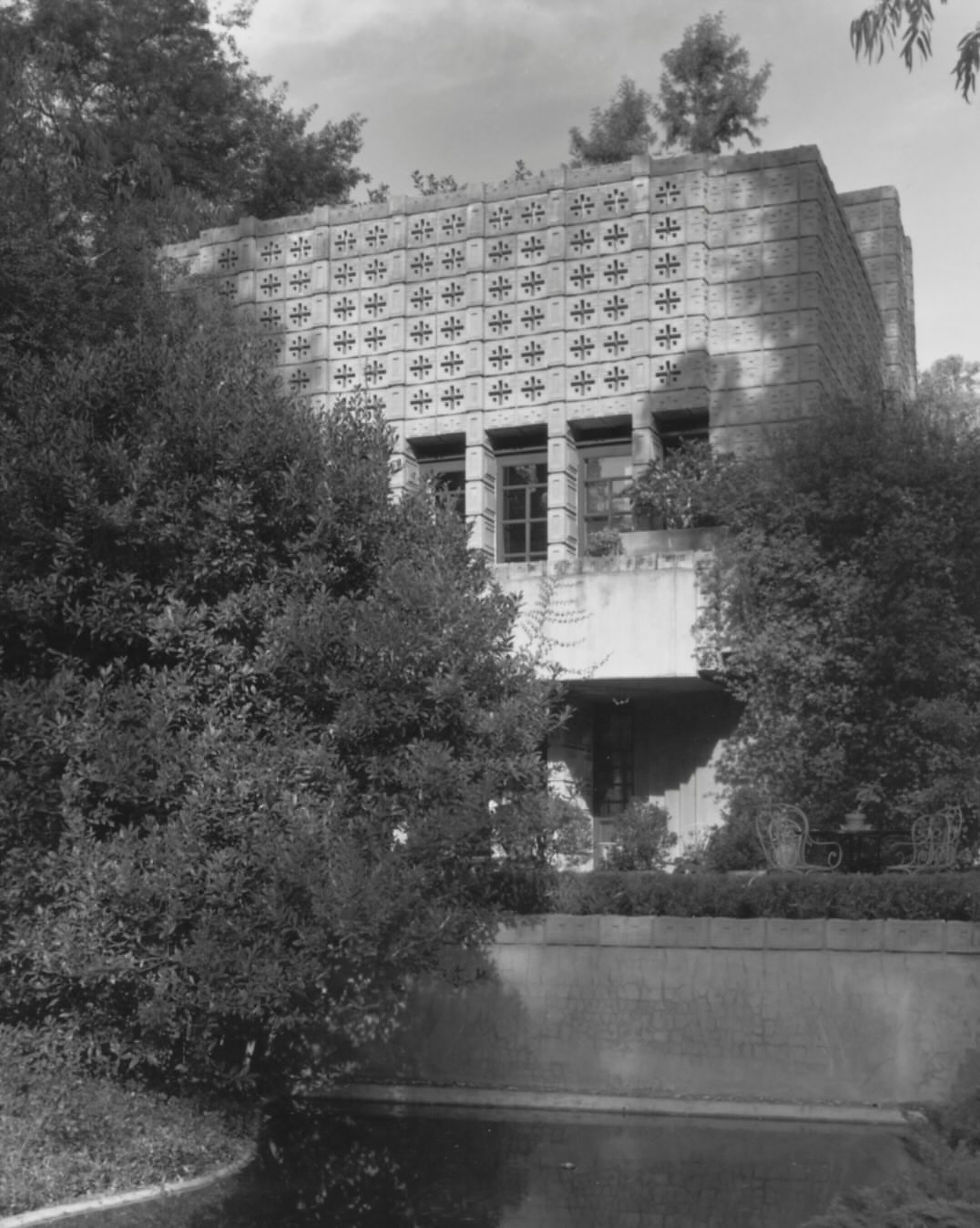
Frank Lloyd Wright’s Millard House, also known as La Miniatura, is one of Pasadena’s most important architectural landmarks and one of the key works of Wright’s Southern California period. Built in 1923 for rare-book dealer Alice Millard, the house was Wright’s first textile block residence, a construction system he would continue exploring in several Los Angeles-area houses.
The house is set into a ravine-like site, making it feel less like an object placed on land and more like something emerging from the landscape. Its patterned concrete blocks, terraces, and intimate relationship to its site reflect Wright’s belief in organic architecture: the idea that a building should grow from its setting, materials, and purpose.
La Miniatura is also important because it shows Pasadena as a place of architectural experimentation. While Greene & Greene developed a wood-based language of craftsmanship and domestic warmth, Wright pursued a more radical system using concrete blocks that could be repeated, textured, and assembled into a new kind of modern architecture. Both approaches were deeply tied to Southern California’s climate and landscape, but they expressed very different visions of the future.
Together, the Gamble House and Millard House make Pasadena one of the most important residential architecture destinations in America.

The Rose Bowl: Civic Spectacle in the Arroyo Seco
The Rose Bowl is known around the world, but its location inside the Arroyo Seco is essential to understanding it. Built in 1922 and designed by architect Myron Hunt, the stadium was created after the Tournament of Roses Association outgrew earlier facilities used for the Rose Bowl Game. The Arroyo Seco was selected as the site, and the stadium became one of Pasadena’s defining civic landmarks.
The Rose Bowl is architecture at the scale of spectacle. It connects Pasadena’s identity to sports, tourism, New Year’s Day ritual, national television, and civic pride. Like the Colorado Street Bridge, it is more than infrastructure. It is a stage for how Pasadena presents itself to the world.
Its design also reflects the city’s relationship to landscape. Rather than occupying a dense urban site, the Rose Bowl sits within the Arroyo, surrounded by parkland and open space. It belongs to Pasadena’s long tradition of turning geography into cultural identity.

Why Pasadena Matters to Los Angeles Architecture
Pasadena is sometimes treated as separate from Los Angeles, but its history is central to the story of the region. The city helped define the Southern California image long before many of L.A.’s most famous neighborhoods took shape. Its architecture shaped ideas about indoor-outdoor living, the bungalow, the garden suburb, the winter estate, the civic bridge, the stadium landscape, and the preservation of historic neighborhoods.
A Pasadena architecture tour is therefore not just a tour of beautiful buildings. It is a tour of how Southern California imagined itself.
The Arroyo Seco shows how landscape shaped settlement. Vista del Arroyo shows the rise and reinvention of resort architecture. The Colorado Street Bridge shows civic infrastructure as art. The Gamble House and Bentz House show Pasadena as a national center of the Arts and Crafts movement. Fenyes Mansion and Grand Avenue reveal the city’s winter colony grandeur. Millard House shows Frank Lloyd Wright experimenting with a new architectural language. The Rose Bowl shows Pasadena turning spectacle into civic identity.
Together, these places explain why Pasadena remains one of the best destinations for architecture lovers, history buffs, preservationists, design enthusiasts, and curious locals looking for meaningful things to do near Los Angeles.
To understand Pasadena is to understand a major chapter of Southern California itself: a place where climate, wealth, landscape, design, ambition, and reinvention came together to create one of the most extraordinary historic cities in California.

Experience Pasadena’s Architecture in Person!
The best way to understand Pasadena is on foot. Its history lives in the details: the curve of a bridge, the grain of a Craftsman beam, the placement of a porch, the slope of a ravine, the shadow of an old mansion wall, the way a street opens suddenly toward the Arroyo.
LA Explained’s Pasadena Architecture & History Walking Tour brings these stories together through a guided experience exploring historic homes, landmark bridges, Arts and Crafts masterpieces, Arroyo Seco landscapes, Greene & Greene residences, Frank Lloyd Wright sites, grand mansions, and the civic landmarks that shaped Pasadena’s identity.
Whether you’re a lifelong Angeleno, a first-time visitor, an architecture lover, or someone searching for unique things to do in Pasadena, this tour offers a deeper way to see one of Southern California’s most historically important cities.
Come walk through the architecture, landscape, and hidden history that made Pasadena the Crown of the Valley!
VIEW GALLERY:


I found this guide at exactly the right time. I had tried several Pinterest download tools before, but most of them either didn't work or were filled with unnecessary ads. This pin downloader was straightforward, fast, and easy to use. Your explanation made the whole process simple, even for someone using it for the first time. Thanks for putting together such a helpful resource.