
Inside the Jonathan Club: The Downtown Institution That Helped Shape Los Angeles
- 21 hours ago
- 13 min read
By Thom Vest
The Jonathan Club stands as one of Los Angeles’s oldest and most exclusive private members clubs. Founded in the late 18th century, it has quietly shaped the social and cultural fabric of the city while maintaining an air of mystery. Join us as we explore the rich history, traditions, and unique character of The Jonathan Club, revealing why it remains both a coveted institution and revered cornerstone of L.A. culture as we know it today.

There are certain buildings in Los Angeles that do not simply sit on their corners. They preside.
The Jonathan Club’s downtown home at Sixth and Figueroa is one of them - a Renaissance Revival landmark wrapped in terra cotta, old-world ornament, private mythology, and more than a century of Los Angeles ambition. In a city that has made an art form out of reinvention, the Jonathan Club has endured as something rarer: an institution that has watched Los Angeles become itself from the inside out.
For generations, its name carried a particular kind of civic weight. The Jonathan Club was where railroad men, newspaper publishers, bankers, attorneys, politicians, developers, entertainers, and business leaders gathered over lunch, drinks, committee meetings, handshakes, and the quiet rituals of influence. It was not the loudest room in Los Angeles. That was rather the point. Like many of the city’s old private clubs, it operated behind closed doors, and those doors opened onto a version of Los Angeles where power was often social before it was official.
One old adage, repeated for decades in discussions of Los Angeles’ private-club hierarchy, put it neatly: “The people who run Los Angeles belong to the Jonathan Club. The people who own Los Angeles belong to the California Club.” It is the kind of line that sounds like it was poured with a martini - sharp, slightly smug, and not entirely wrong.
But the full story of the Jonathan Club is more complicated, and far more interesting, than a simple tale of power in paneled rooms. It is a story about Los Angeles as a young frontier city trying to become a metropolis; about architecture as civic theater; about exclusivity, aspiration, reinvention, and belated progress; and about how one private club evolved from a politically minded gathering of late-19th-century Angelenos into one of Southern California’s most enduring social institutions.

From Political Club to Social Powerhouse
The Jonathan Club traces its origins to the late 1800s when Los Angeles was still a city in the process of becoming. The population was growing, railroads had transformed Southern California’s accessibility, and the region’s boosters were selling Los Angeles with near-religious conviction. Sunshine, oranges, real estate, opportunity - the ingredients were already there. What Los Angeles needed was infrastructure, capital, confidence, and the men who believed they could supply all three.
While officially founded in 1895, the club actually began in 1894 as a political organization backing presidential hopeful William McKinley, but its partisan phase was brief. By 1895, it had shifted into a purely social club and was formally chartered in California. That pivot says a great deal about the era. In late-19th-century Los Angeles, social life and civic influence were deeply intertwined. A club did not need to be officially political to matter politically. In many ways, the social club was the political machine’s better-dressed cousin.
The name itself came from “Brother Jonathan,” a patriotic figure used as a kind of early American symbol before Uncle Sam fully took over the national imagination. There is something almost funny about that in retrospect: a club that would become synonymous with exclusivity taking its name from a democratic folk symbol. But Los Angeles has always loved a reinvention.

The earliest Jonathan Club quarters were modest compared to what would come later. The club occupied rooms on Spring Street, then the city’s commercial and civic spine. This was the Los Angeles of newspaper offices, banks, hotels, streetcars, lunch counters, courtrooms, cigar smoke, and civic boosterism. Downtown was the center of gravity, and Spring Street was one of its principal stages.
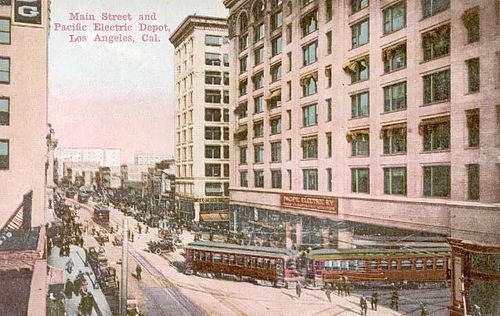
As the city expanded, so did the club’s ambitions. Its membership grew, its influence widened, and its physical surroundings had to keep pace. Eventually, the Jonathan Club moved into the top floors of the Pacific Electric Building - an address that placed it quite literally above one of the great symbols of early Los Angeles modernity.
The Pacific Electric Years
The Pacific Electric Building was more than an office building. It was the nerve center of a regional transportation empire. From there, Henry Huntington’s red cars helped stitch together Southern California, connecting downtown Los Angeles to beaches, suburbs, citrus towns, and emerging communities across the basin.
For the Jonathan Club, occupying the upper floors of that building was both convenient and symbolic. The club was no longer simply in Los Angeles. It was above the machinery of Los Angeles growth. During these years, the Jonathan Club became a gathering place for figures who helped shape Southern California’s economic, cultural, and civic future. Its own historical materials point to members and guests connected to the development of UCLA, the growth of the region’s agricultural industries, and the broader transformation of Los Angeles from a fast-growing city into a national force.
The club’s influence was not always visible in the public record because that was the nature of the institution. Clubs like the Jonathan operated through proximity. They created rooms where ambitious people met other ambitious people, where an introduction over lunch could become a board appointment, a development deal, a civic project, or a cultural shift. In a city often caricatured as rootless, the Jonathan Club offered something old cities understood well: a private architecture of connection.
By the early 1920s, however, Los Angeles had outgrown its old self. The city was booming. Oil money, entertainment money, railroad money, real estate money, and banking money were all circulating at astonishing speed. Downtown was filling with grand hotels, office towers, theaters, department stores, and clubhouses. If the Jonathan Club intended to remain one of the city’s defining institutions, it needed a home that announced that status.
It found that home at Sixth and Figueroa.

Building a Clubhouse for a Boomtown
Work began on the Jonathan Club’s permanent downtown clubhouse in 1924, during one of the most feverish building periods in Los Angeles history. The site, at what is now 545 South Figueroa Street, placed the club on a prominent downtown corner just west of the city’s older commercial core. This was Los Angeles pushing outward and upward, one prestigious address at a time.
For the design, the club hired Schultze & Weaver, the New York architectural firm whose work would become synonymous with luxury, hospitality, and high-style urban glamour. The firm also designed major hotels including the Los Angeles Biltmore and, later, New York’s Waldorf Astoria. That pedigree mattered. The Jonathan Club was not commissioning a casual clubhouse. It was building a civic stage set for the city’s ruling class.

Completed in 1925, the clubhouse was conceived as a fully appointed urban world: dining rooms, lounges, athletic facilities, private rooms, meeting spaces, a library, a pool, a roof terrace, and a substantial garage — a very Los Angeles amenity before the city had fully admitted just how car-defined it was about to become.
The building’s Renaissance Revival character gave downtown a dose of European grandeur filtered through 1920s American ambition. Its exterior projected permanence, but the interior delivered theater. Marble, mahogany, decorative ceilings, formal rooms, athletic spaces, and carefully choreographed social environments made the building feel less like a facility and more like a private city within the city.
One of its great artistic signatures came from Giovanni Battista Smeraldi, the Italian-born, Vatican-trained decorative painter whose work also appeared in some of America’s most prestigious interiors. At the Jonathan Club, Smeraldi’s painted ceilings helped transform the clubhouse into something richer than architecture alone. They made the rooms feel ceremonious. To step inside was not merely to enter a club; it was to enter an atmosphere.
And atmosphere, in Los Angeles, has always been a form of currency.

The Club and the City
The Jonathan Club’s rise mirrored the rise of Los Angeles itself. When the club began, Los Angeles was still shaking off its frontier edges. By the time its Figueroa clubhouse opened, the city had become a national spectacle - a place of motion pictures, oil fields, speculative real estate, resort hotels, citrus wealth, aviation dreams, and civic boosterism on a near-operatic scale.

Private clubs were central to that era’s social architecture. They were where members ate, drank, exercised, networked, negotiated, celebrated, and withdrew from public life. For businessmen and civic leaders, they functioned as offices without letterhead. For a certain class of Angeleno, membership was not just recreation. It was positioning.
The Jonathan Club stood among several elite institutions in Los Angeles, including the California Club and the Los Angeles Athletic Club, but it cultivated its own identity. If the California Club was associated with old-line wealth and ownership, the Jonathan Club became linked to action, enterprise, and civic movement - the people building, managing, expanding, and directing Los Angeles.

That distinction may have been exaggerated by legend, but legends are often useful because they reveal how a city sees itself. Los Angeles was never simply a company town, a real estate town, or an entertainment town. It was all of them at once. The Jonathan Club became one of the rooms where those worlds overlapped.
Hollywood also found its way into the story. The club’s history intersects with stars, studio figures, writers, and entertainers, reflecting the growing importance of the film industry in the city’s identity. Los Angeles’ private clubs were not separate from Hollywood’s rise; they were part of the same social ecosystem. Deals might be made at studios, hotels, restaurants, or clubs, but the city’s true operating system was relationship.
The Jonathan Club understood that long before “networking” became a verb.

The Beach Club and the Southern California Ideal
In 1927, the Jonathan Club expanded its world westward with the Beach Club in Santa Monica. If the downtown clubhouse represented Los Angeles’ urban ambition, the Beach Club represented its coastal fantasy.
The pairing was almost too perfect: a formal town club in the Financial District and a seaside retreat on the sand. Together, they captured the dual promise of Southern California life — business in the city, leisure at the ocean; mahogany by day, salt air by sunset.
The Beach Club added another dimension to the institution’s identity. It was not simply about downtown power anymore. It was about lifestyle, family, recreation, and the particular luxury of moving between the city’s centers of influence and its natural pleasures. For members, the two houses created a private map of Los Angeles aspiration: the boardroom and the beach, both under one name.

That duality remains essential to the Jonathan Club’s modern identity. The downtown Town Club and the Santa Monica Beach Club are distinct environments, but together they tell a larger story about what Los Angeles has always sold to itself and to the world: seriousness without severity, glamour without winter, ambition with a view.
The Uncomfortable Part of the Story
In order to tell the history of the Jonathan Club honestly, one also has to acknowledge the history of exclusion that shaped many private clubs of its era. For much of the 20th century, elite social clubs across the country often reflected and reinforced the racial, religious, gender, and class hierarchies of the society around them. Los Angeles was no exception. Private clubs helped consolidate power, but they also helped define who had access to that power - and who did not.
The Jonathan Club, like almost all other elite institutions, faced scrutiny over discriminatory membership practices and unequal access. Practically anyone who wasn't a white male with direct proximity to power in one way or another was historically denied, rejected, or restricted access to spaces that presented themselves as private but often functioned as important arenas of business and civic life.
That distinction mattered. But by the 1970s and 1980s, pressure was mounting nationally and locally against discriminatory private clubs, especially those that served business purposes while claiming purely private status. In Los Angeles, the debate came to a head in the 1980s, when city officials moved to prohibit discrimination by large clubs that were not considered “distinctly private.” The Jonathan Club was among the institutions affected by that changing legal and cultural landscape.
Women were admitted as members in the late 1980s, marking a major turning point in the club’s evolution. It was a long-overdue change, and it came in the context of broader civic pressure, legal scrutiny, and a changing Los Angeles that could no longer be credibly represented by rooms closed to so many of its people.
This part of the story should not be treated as a footnote, nor should it be used to flatten the club’s entire history into indictment. Both things can be true: the Jonathan Club is an architecturally significant, culturally important Los Angeles institution, and it was also part of an exclusionary social order that limited access to power for generations.
The more interesting story is how institutions evolve when the city around them demands it - and more importantly - how it moves into a new era decades after those demands have already been met.

Reinvention Without Erasure
Today, the Jonathan Club presents itself very differently than it did in its early decades. Its public language emphasizes diversity, community, service, wellness, culinary programming, social events, cultural engagement, and philanthropy. The modern club describes its members as coming from different backgrounds, professions, talents, and heritages - a notable contrast to the narrow social profile historically associated with elite private clubs. That evolution reflects Los Angeles itself. The city of the 1890s was not the city of the 1920s, which was not the city of the 1980s, which is certainly not the city of today. Los Angeles is now one of the most diverse major cities in the world, shaped by global migration, entertainment, technology, design, food, activism, entrepreneurship, and culture in every possible register. Any institution that hopes to remain relevant here has to evolve or calcify.
The Jonathan Club appears to have chosen evolution.
Its downtown building has undergone careful restoration and modernization, balancing the preservation of historic rooms with contemporary amenities. Its current programming extends beyond the old private-club model of dining and business lunches into wellness, events, cultural programming, community service, and member experiences. The Beach Club continues to offer the coastal side of the Jonathan identity, while the Town Club remains one of downtown’s most atmospheric interiors.
The result is an institution trying to carry its history without being trapped by it. That is not an easy thing to do in Los Angeles, where reinvention often comes with demolition. The Jonathan Club’s great advantage is that it still has the building - the actual rooms, ceilings, stairways, terraces, and rituals that connect the present to the past. In a city notorious for losing its own evidence, that matters.

A Landmark of 'Private' Los Angeles
The Jonathan Club is not public in the way a museum, park, theater, or civic building is public. Most Angelenos will never casually wander through its lobby or linger beneath its painted ceilings. That is part of what makes it fascinating. It belongs to a category of Los Angeles landmarks that shape the city from just outside the public eye.
Private Los Angeles is still Los Angeles. In fact, some of the city’s most consequential history has unfolded in private rooms: studio offices, hotel bars, restaurant booths, club dining rooms, backyard salons, hillside living rooms, beach houses, and boardrooms above street level. The Jonathan Club is one of the most enduring examples of that hidden civic geography.
Its story is also a reminder that architecture is never just architecture. A clubhouse is a social machine. It tells people where to enter, where to sit, who belongs, who waits, who dines upstairs, who is allowed in the room, and who has to build a different room somewhere else. Over time, those rules change. Sometimes slowly. Sometimes because the law changes. Sometimes because the city around it changes. And sometimes because the old arrangement simply becomes impossible to defend.
And that is where tradition is either preserved with purpose - or mistaken for permanence. The true test of any institution is not whether it can hold on to the past unchanged, but whether it can carry forward what is meaningful - the ritual, the architecture, the sense of belonging, the civic memory - while adapting to the world as it actually exists here, now, and today. In that sense, the torch is passed from one generation to the next not simply to protect what came before, but to refine it, expand it, and make it more reflective of the city and community it now serves.
The best and longest lasting institutions do not survive by pretending time has stopped. They survive by knowing what is worth preserving, what must be left behind, and how to make room for the next generation without losing the soul of the place.
The Jonathan Club’s building remains beautiful, but its real historical significance lies in how much and how many versions of Los Angeles passed through it: the ambition, exclusion, reinvention, influence, ritual, glamour, contradiction, and the part I always find most interesting and important - the progress.

The Club That Stayed
Los Angeles is not sentimental with its past. It tears down restaurants, theaters, hotels, bungalows, mansions, and entire neighborhoods with terrifying ease, then names the replacement after whatever was lost. That the Jonathan Club still stands at Sixth and Figueroa after a century is remarkable in itself.
It has survived downtown’s booms and busts, the rise and fall of streetcar Los Angeles, the freeway age, white flight, corporate downtown, the decline of the old Financial District, the return of residential downtown, and the modern revival of private members’ clubs. It has watched the city move west, sprawl outward, rediscover downtown, and remake itself new again, again, and again.
Through all of it, the Jonathan Club remained.
Not unchanged - and that part is very important - but present. Present as architecture. Present as institution. Present as memory. And present as a reminder that Los Angeles has always had its formal rooms where dress shoes clack against exotic wooden floors, and gilded cherubs gaze down from above as chance encounters or a handshake over lunch could help redraw the city skyline forever. For all its sunlit informality, I for one think Los Angeles has never really been quite as casual as it likes to pretend.
The Jonathan Club’s story, then, is not simply the story of an exclusive private club, or a really fabulous piece of historic LA real estate. It is a story about how power and influence once moved through the city of Los Angeles - quietly, ceremonially, and often behind closed doors - and how, slowly, imperfectly, and necessarily, those doors had to open wider in order to see the city as it is today more clearly.

Today, the grand clubhouse still rises over Figueroa with the confidence of another era. Inside, the ceilings still glow, the rooms still whisper, and the grand pillars still carry their old charge. But the meaning of a place like this is no longer only in what it preserves. It is also in what it chooses to leave behind, in how it sheds the dogma of the past to make way for a brighter future, and in how it continues to make room for the city around it.
A landmark built to endure, in a city built to change. A house of tradition standing inside a metropolis of reinvention. And if the Jonathan Club’s next chapter means anything, it is that history does not have to disappear in order for progress to enter the room.
It’s all very Los Angeles, really.


Comments